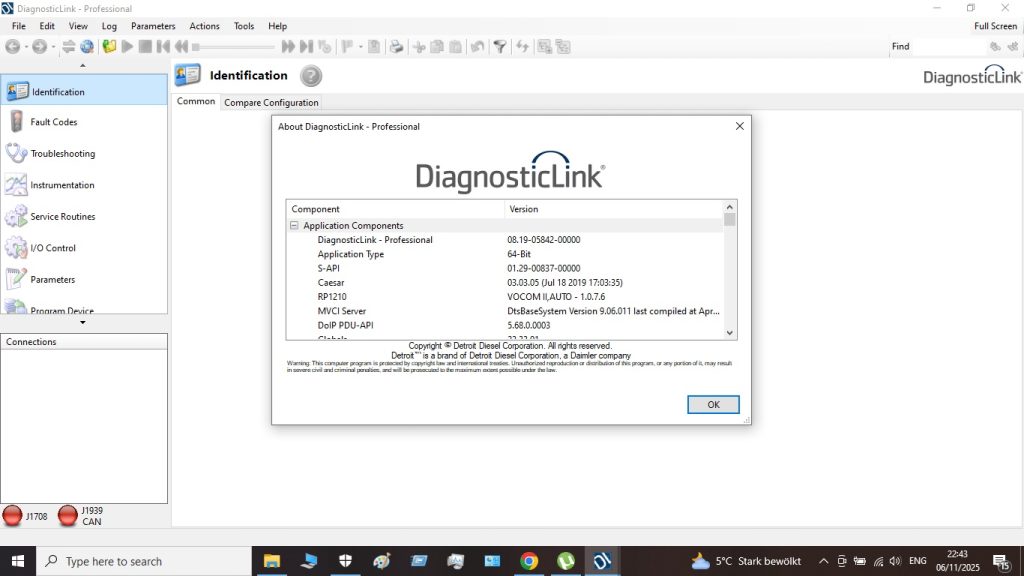
Why Run JPRO 2025 v2 on VMware?
JPRO 2025 v2 is Windows-only software. If your machine runs macOS, Linux, or an older Windows version, running JPRO inside a VMware virtual machine is a practical solution. VMware also lets you create a clean, isolated Windows environment — preventing driver conflicts that can affect JPRO on shared machines.
This guide uses VMware Workstation Pro 17 with a Windows 10 or 11 guest OS.
What You Need Before Starting
- VMware Workstation Pro 17 (or VMware Fusion 13 on macOS Intel)
- Windows 10 or 11 ISO (64-bit)
- JPRO 2025 v2 installer (from firstdiag.com)
- RP1210 adapter (NexIQ USB-Link 2/3 or Noregon DLA+ 2.0)
- 50 GB free disk space for the VM
- Internet connection for JPRO license activation
Apple Silicon (M1/M2/M3) note: VMware Fusion on Apple Silicon runs ARM Windows. NexIQ RP1210 drivers are x86/x64 only and may not work on ARM. An Intel Mac or Windows PC is strongly recommended.
Step 1 — Create the Virtual Machine
- VMware Workstation Pro 17 → File → New Virtual Machine → Typical
- Select your Windows 10/11 ISO
- Set VM Name:
JPRO-2025 - Set disk size: 80 GB minimum, single file
- Customize Hardware before finishing: RAM 4–8 GB, 2 CPU cores, USB Controller set to USB 3.1, Network set to NAT
- Click Finish → Power On
Step 2 — Install Windows
- Follow Windows setup wizard — select Windows 10/11 Pro (64-bit)
- Choose “Custom install” → select the VMware virtual disk
- After boot: VM menu → Install VMware Tools → follow prompts → restart
Step 3 — USB Passthrough (Critical)
- Plug the NexIQ adapter into your host machine’s USB port
- In VMware: VM menu → Removable Devices → find your NexIQ → click “Connect (Disconnect from Host)”
- The adapter should now appear in Windows Device Manager inside the VM
- To automate: VM Settings → USB Controller → check “Automatically connect new USB devices”
Step 4 — Install NexIQ RP1210 Drivers
- Inside the VM, download the latest NexIQ USB-Link 2/3 drivers
- Run the driver installer as Administrator
- Restart the VM after installation
- Verify in Device Manager — adapter appears with no error flags
Step 5 — Install and Activate JPRO 2025 v2
- Copy JPRO installer into the VM (drag-and-drop works with VMware Tools)
- Right-click installer → Run as Administrator
- Disable Windows Defender temporarily during installation
- Launch JPRO 2025 v2 → enter license key → activate (NAT networking provides internet)
- Re-enable Windows Defender, add JPRO folder to exclusions
Step 6 — Connect to Truck and Test
- With VM running, connect NexIQ adapter to truck’s 9-pin diagnostic port
- Confirm adapter is connected to the VM (VM → Removable Devices)
- Turn truck ignition to ON
- Open JPRO → New Session → wait for ECU auto-detection (15–30 seconds)
Troubleshooting
| Problem | Cause | Fix |
|---|---|---|
| Adapter not found in VM | USB passthrough not set | VM → Removable Devices → manually connect NexIQ |
| No ECUs detected | Adapter connected to host, not VM | Disconnect from host, reconnect to VM |
| License activation fails | VM using Host-only network | Change to NAT in VM Settings → Network Adapter |
| JPRO crashes during parameters | Insufficient VM RAM | Increase VM RAM to 8 GB |
| Driver installation fails | Windows Defender blocking RP1210 driver | Disable Defender during install, add NexIQ folder to exclusions |